Brett’s Story: “Nothing ventured, nothing gained”
Latest News Patient Stories

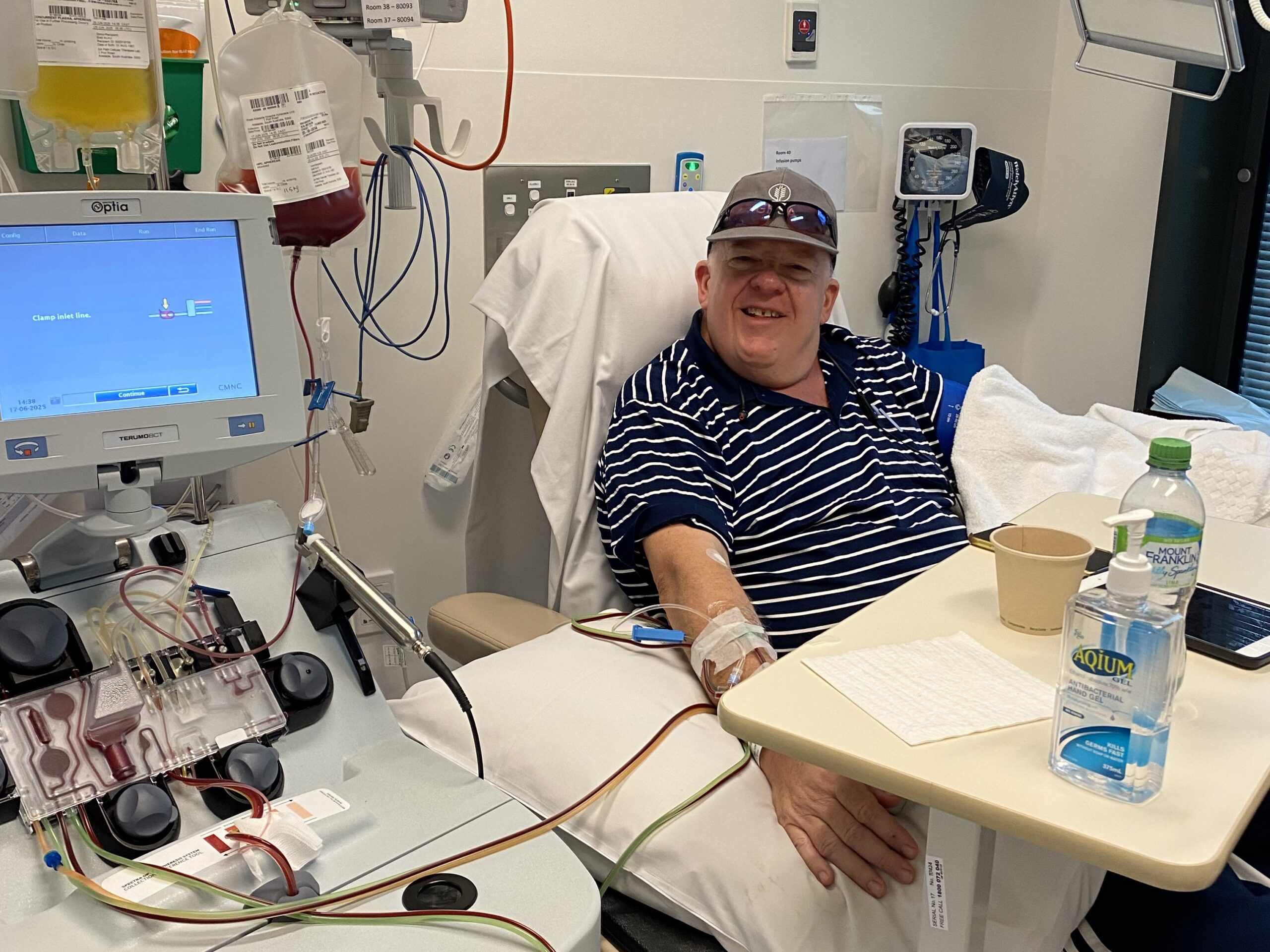
When Brett’s haematologist handed him a flyer suggesting he could consider participating in a new clinical trial, his first reaction was simple: “Why not?”
He had just completed his fourth round of chemotherapy for multiple myeloma and was preparing for an autologous stem cell transplant, including five days of stem cell harvesting. Curious to learn more, he took the brochure home and read it over breakfast the next day.
The trial – the HSCT Biome Study being conducted by the University of Adelaide and South Australian Health and Medical Research Institute – was designed to test a new approach to preventing the gut-related side effects of chemotherapy and stem cell transplantation. Treatment often wipes out healthy gut bacteria, causing diarrhoea, infections, ulcers, severe pain and difficulties absorbing nutrients. The study was looking at whether taking faecal microbiota transplantation (FMT) capsules – “poo pills” – in the days leading up to transplant could help protect and restore the gut.
Rather than being put off by the concept, Brett was intrigued.
“I’ve always had a STEM (Science, Technology, Engineering and Maths) mind – pardon the pun, with the stem cell transplant,” he joked. With an engineering background, the science appealed to him. “If it doesn’t work, it doesn’t work,” he thought. “Nothing ventured, nothing gained.”
“They explained all of the risks and everything that could happen,” Brett said. “But my take on it was that those things rarely eventuate, and that the potential benefits far outweighed any risks in doing the trial.”
The idea of taking a capsule made from freeze-dried stool didn’t phase him either. “The research team told me only 2-3% of people meet all the health requirements to be a faecal donor. I figured if it came from someone that healthy, it can’t be too bad for me. And honestly, can it be any worse than some of the nasties in chemotherapy?”
Living in Port Lincoln, several hours from Adelaide, Brett wasn’t sure how he would receive the frozen capsules in time. The capsules had to be taken for 10 days before the transplant, and he was already only 12 days out. But the research team was keen to include him, and they moved quickly.
Taking advantage of Port Lincoln’s reputation as the “Seafood capital of Australia” the resourceful research team came up with a creative solution to solve the freight problem. That night, a refrigerated road train was loaded with a lunch-box sized container of Brett’s capsules, travelling alongside frozen pallet sized blocks of fish feed headed to the tuna farms. Brett collected the package from the local freight depot the next morning and began the 10 day program. He became just the third person in South Australia to participate in the trial.
He knew there was a chance he may be on the placebo. But his attitude remained steady “It’s the luck of the draw.”
For the next 10 days, Brett took the capsules while the research team called every second day to check in. “The tablets and calls were no great impost,” he said.
Soon after, he travelled to Royal Adelaide Hospital for his transplant. Each day, researchers from the University of Adelaide and South Australian Health and Medical Research Institute visited him. They asked a series of standard questions which would take 5-10 minutes each day, about his symptoms, mindset, and bowel movements. They also recorded the results of his daily blood tests, which were already being taken by the hospital.
The transplant went well. Of the very common symptoms, Brett only experienced slight nausea once, very little diarrhoea, no mouth ulcers, and he was able to keep eating – though he admits at times he wasn’t jumping out of his bed for food.
“I can only assume the capsules must have helped,” he said. “But I might just be predisposed to fewer side effects. You can never know for sure.”
With Brett’s great progress, he was able to bounce back and return home exactly four weeks after the transplant. He is grateful, knowing how difficult the experience can be for others – especially the vicious cycle of nausea and diarrhoea that some patients face.
Back home, he continued the capsules for another week, with ongoing check-ins from the research team.
For anyone considering joining a clinical trial, Brett’s message is simple:
“Give it a go.”
He found the process not “overly onerous” and the research team “extremely understanding, easy to get along with and passionate.” They provided a small freezer in his hospital room for optimum storage of the capsules and even a tick chart to help keep track of doses.
“Be prepared,” he says. “Some trials might feel awkward or embarrassing. You will need to provide samples and feedback including being asked about your wellbeing, and sometimes things like bowel movements. But it’s all in the name of science. And if I can be a part of something that becomes standard treatment in the future, then that will be great”.
For further information about clinical trials, speak to your treating team.