Mitchell Jones: A Different Mountain to Climb
Arrow Stories Latest News Patient Stories


In 2022, Mitchell Jones was working as a freelance videographer and photographer, a career he had built over the past ten years. He was working hard, prioritising work and his family and as a result had not been putting too much thought into his own personal health.
“I was reasonably active,” Mitchell says, “but I wouldn’t say I was fit at all. I was probably in a bit of a slump over those ten years.”
When the COVID pandemic hit in 2021, work instantly dropped off. Like many freelancers, the financial pressure was intense, adding stress to an already uncertain time. It was during this period that Mitchell re-engaged with a sport he loved – mountain biking.
Rediscovering a Passion
Mountain biking was something Mitchell had done throughout his teenage years. He loved motorbikes, motorcross, and being outdoors. Returning to mountain biking during COVID felt rewarding and invigorating.
“It was a great stress outlet,” he recalls.
Mitchell says “It became much more than just an escape — it was my fitness, my meditation, my connection with nature. It quickly became my favourite thing to do and a huge part of my identity during that time.”
During lockdowns, Mitchell rode about three times a week, riding up and down the mountain and along the beautiful rainforest trails of Mount Kembla, near where he lived. The regular ride became a good yardstick – an easy way to gauge how his body and fitness were responding, especially after he contracted COVID.
“I felt like I was getting fit again and was probably in the best condition I had been in for about 10 years,” he says. “I felt in a pretty good place physically and mentally. I was feeling pretty great, especially coming off the back of COVID, and all that stress.”
When Something Didn’t Feel Right
As Mitchell recovered from COVID, however, something changed. The rides that had once felt manageable suddenly became harder. He began to struggle more than usual on his rides and developed painful and persistent chest pains.
Concerned, his GP sent him to the emergency department for an ECG and some other tests. Later Mitchell received a phone call from his GP that made his stomach drop.
Scans had revealed a large mediastinal mass in his chest – roughly the size of a medium steak.
In January 2023, Mitchell underwent surgery to remove the mass. When he woke, he was met with devastating news.
“I’m really sorry,” doctors told him. “But it looks like it’s a cancerous lymphoma”.
“That was pretty crushing,” Mitchell recalls.
Biopsy tests later revealed it was in fact a rare form of leukaemia, ALL, in the form of a tumour.
Treatment and Transplant
Surgeons were able to remove most of the tumour, but small remnants remained around arteries close to his heart and could not be safely removed. Fortunately, the cancer appeared localised to that tumour, and was not appearing anywhere else in his body or blood.
Following discussions with his haematologist, a treatment plan was developed: chemotherapy to get the cancer into remission followed by a stem cell transplant, in the hope of stopping the cancer from ever coming back.
Chemotherapy began just two weeks after surgery and continued over the next six months. A regular regime commenced of two weeks in hospital receiving chemotherapy as an inpatient, a few weeks at home, then back into hospital again, travelling back and forth between Wollongong Hospital. This continued until July 2023, when the doctors became satisfied that the cancer was in remission and not showing any more growth.
Throughout this time, Mitchell hadn’t had the chance to think much about the final phase of his treatment – a stem cell transplant. “It just felt like the icing at the end,” he says. “I was focussed on getting through the surgery and the chemotherapy. I didn’t really think much about the stem cell transplant, I was just dealing with everything else that was in front of me”.
Two months later, the stem cell transplant began with radiation. Mitchell had been fortunate not to experience too many side effects from the chemotherapy and did not get any mucositis. “I managed to dodge all of that through chemo, so I was hoping for pretty good results from the stem cell transplant process.”
Unfortunately, that wasn’t the case. During transplant, Mitchell developed severe mucositis. A feeding tube was inserted pretty early on, but it was uncomfortable and unsettling, and eventually removed.
“The mucositis was so bad I couldn’t even get a drop of water down to swallow,” he says. “I was on about four IV pumps going at the same time. That was a full on experience.”
Constant alarms from machines and strong pain relief left him sleep deprived.
“A lot of the time if felt like I was sort of half awake, half asleep. I had dreams and was coming in and out of reality. It was a weird time.”
The Long Trail Back
Five weeks after his transplant, Mitchell was well enough to leave the hospital and move into nearby accommodation. He had relocated from Wollongong to Sydney for treatment at St Vincents Hospital, and his wife and son travelled up on weekends to visit.
During this time, Mitchell experienced a bladder infection, but fortunately did not have too many other symptoms or any significant graft versus host disease. Physically, however, he was extremely weak.
“I remember going out for my first meal at a quiet local pub and struggling to walk up a slight hill. It felt so hard at the time”.
Recovery began with simple movement. Walking became his first focus and eventually Mitchell was walking daily. He would try and walk a couple of kilometres every day. “That’s how I started with the physical recovery side of things. Just walking”.
By the end of 2023, after a year in and out of hospital, Mitchell was finally home. But life didn’t return to normal straight away. He was very conscious of avoiding infection and spent a lot of time at home.
“I didn’t do much for quite a while to be honest,” he says. “I was pretty isolated. I was a bit scared of catching anything and how my immune system would react. I spent a lot of time at home, just me and the dog while my son was at school and my wife was working.”
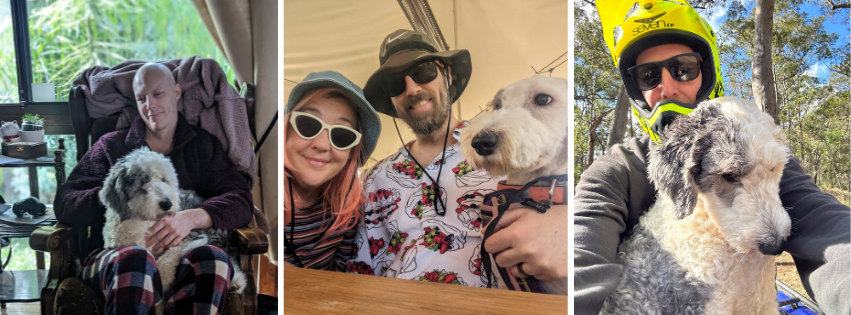
Mitchell’s dog, a Sheepadoodle, provided strong motivation during his recovery.
“I got into a routine taking her for a walk. She was my main motivation actually, because there was a lot of time when I didn’t feel like going out, but I would feel bad enough for her that I would take her for a walk.”
Mitchell enjoyed walking around the neighbourhood and along the beach. “Taking her to the beach was great. I was outdoors in the fresh air, away from people, it was nice”.
Returning to Nature and Strength
From there, Mitchell literally took things one step at a time. “I started with some small bushwalks, out on the trails that I used to ride.”
His first return to the forest was a really emotional time after being isolated in hospital for so long.
“I remember getting quite teary over how nice it felt and how much I had missed experiencing the outdoors and nature,” he says. “It was a pretty profound experience. Even feeling the rain on my skin was the most amazing feeling because it is the complete opposite feeling of what it is like to be stuck in hospital and looking outside of the window while being hooked up to machines”.
This reconnection with the great outdoors, gave Mitchell a greater appreciation of how important it is for his wellbeing to spend time in nature.
“Being in the rainforest made me realise how much peace I get from that. There would be times I would ride up the hill through the trees and be surrounded by butterflies, and the sun would be shining through, and it really is sort of magical. It is definitely my happy place”.
In 2024, Mitchell continued his slow recovery, still experiencing weakness and fatigue, and would often need day time naps, despite not doing much through the day. He gradually returned to work taking on a few small videography jobs. “That was totally exhausting to be honest. I felt pretty wrecked after a few hours work.”
Mitchell accepted that 2024 would need to be his recovery year and focussed on fast tracking his physicall recovery. “I mentally resigned myself to the fact that this is going to be my recovery year, and to sort of write this year off, take it easy and see how things go.”
By 2025, Mitchell was continuing to struggle with the effects of fatigue and weakness. “The stem cell transplant had destroyed me physically,” he said. So he went to his GP who referred him to an exercise physiologist and gave him a care plan for 10 visits.
The exercise physiotherapist designed an exercise routine that he could do at home. The goal was to work towards completing the exercise plan three times per week, alongside walks with the dog. The ultimate goal was to get back to Mitchell’s passion of mountain bike riding.
Mitchell said “Working with the exercise physiotherapist was very, very productive. I have never been a gym guy, I have always preferred more activity based stuff and outdoor things. I have always struggled locking in a gym routine or finding the motivation to keep going. But this was good. This was probably the most motivated I have felt.”
The positive results came quickly for Mitchell to the point where he actually began enjoying workout routines “Once I started, it sort of became addictive, seeing how much it improved my strength and fatigue”.
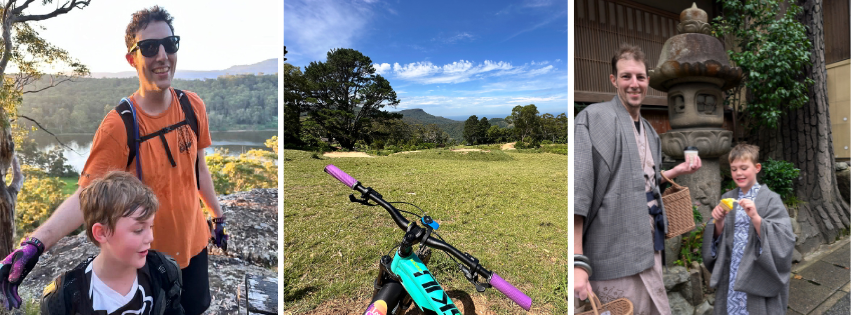
Progressively Mitchell got back into bike riding. It started with some casual rides, riding with his son, and eventually progressed to trail rides. A massive network of new trail rides had opened up in Mitchell’s local area which he was really keen to try.
“It was really hard at first, going back to that same hill, which was my fitness benchmark during COVID. I have never struggled like that before. My stamina was shot. It was really, really eye opening for me.”
But that difficulty became motivation for Mitchell. He recalled when as a teenager he was constantly trying to chase the older riders who were stronger and fitter than he was.
“I would ride all the way up Mount Keira, which felt impossible. I would not ever had the motivation to do it if I hadn’t been trying to follow other people that were doing it. That pushed me and gave me the motivation to keep up”.
Similar to Mitchells teenage days he used the inspiration of his ‘old self’ to push him along. As he tried riding up what felt like an impossible hill, where he felt physically ill and like he wanted to vomit he would say to himself “OK, I don’t feel like I can do this now, but I used to be able to do it. So I just need to push through and try and follow my ‘old self’ to do this.”
That became Mitchell’s motivation to push him through the barrier of feeling like he could not do it. As the weeks went on, Mitchell encouraged himself further, reminding himself that if he just went a little bit further today, then next week would be easier.
Eventually by the end of 2025 he made it to the top of that hill and got back into riding three times a week. “Riding that new trail network was amazing. Once I started, I couldn’t stop. I really got the bug for mountain biking again”.
The exercise program began to take a bit of a back seat as Mitchell prioritised the exercise he was loving – mountain bike riding. But that focus changed when later in the year Mitchell had an accident whilst out on a short ride, slipping into a tree and breaking his collarbone. Mitchell suspects the lower bone density post transplant played a part in the break along with an unlucky angle of the fall. The accident set Mitchell back a little, bringing him back to the daily walks of the dog and the home exercise and strength program that he was originally set post transplant, as his daily form of exercise.
A Changed Perspective
Reflecting on the past few years, Mitchell has realised that he now has a different outlook and perspective on life.
“This whole process (of a stem cell transplant), has really sort of changed my personality a bit. Before I got unwell I was living the freelance lifestyle – always trying to hustle, always feeling like I needed to get somewhere else. I felt the need to get more money, be more successful and quite honestly felt quite stressed most of the time. I found it very hard to sit down and just relax or genuinely just chill without feeling like there was something I needed to be working on or aiming for.
And then suddenly I am in this situation where I have very little control over anything that’s happening. A whole year of operations and treatment. It felt like I was on a rollercoaster. I just had to strap in, trust the medical team, and ride it out to the end.
That experience has changed me quite a bit. It has made me more accepting of the things I don’t have any control over and more at peace. Now I prioritise my health above everything else. When you’re sitting in hospital thinking about life, it just seems absolutely crazy that you would prioritise work before your own health. My goal now is to give myself some time to heal and recover and try and get a bit of control back over my life and health.
The transplant did not just cure the cancer in me, it fixed other things in me too.”
One of Mitchell’s biggest motivations now is being the best role model he can be for his son, and creating more memories with his family and friends. After everything he has been through, he is determined to make the most of this second chance at life.
Mitchell is grateful for the position he is in now, and recognises that not everyone makes it, and that he is one of the lucky ones. But he does hope that by telling his story he can inspire others going through treatment. “My wife has a catch phrase which resonates with me – “if you see it, you can be it”. I truly believe having a positive outlook really does help towards your physical outcomes. It is important not to feel hopeless in that situation. There is so much you can not control when getting a stem cell transplant, but you can choose how you feel about things and your attitude. If I can spread a bit of hope and positivity for people that are going through a stem cell transplant, I think that really matters.”